
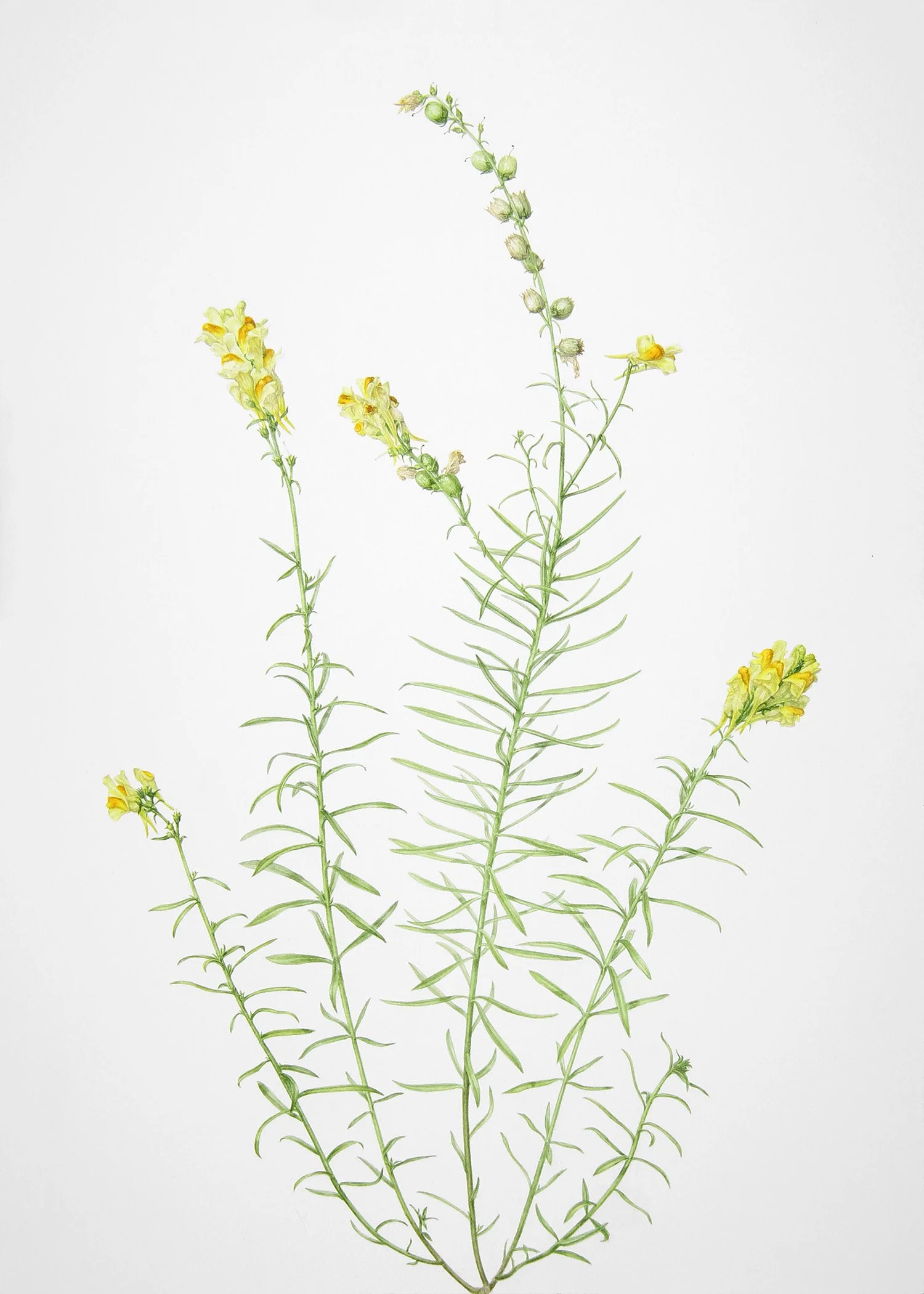
Linaria vulgaris (Yellow Toadflax), 2026
watercolour on paper, 16.5” x 11.75”
A perennial native to Europe and most of Asia, Linaria vulgaris was introduced to New England as a garden ornamental in the mid to late seventeenth century. Its attractive yellow flowers helped drive its spread through North America, but it was also transported as a contaminant in hay and along railways. Early in the nineteenth century, yellow toadflax was present in Quebec and spread westward, reaching Saskatchewan by 1918. The species was first recorded in Alberta near Peace River in the mid-1920s, thought to be introduced as a contaminant in alfalfa seed imported from the United States. By the 1940s, yellow toadflax was well established in the province and considered a serious agricultural weed. Infestations can reduce crop yields by as much as 20%, and the plant’s bitter-tasting compounds make it unpalatable and mildly poisonous to livestock.
Though seed germination rates are relatively low, a single yellow toadflax plant can produce up to 30,000 seeds per year. However, the plant is very adept at reproducing through its extensive root system. Rhizomes can spread between one and two metres each year, and new plants can grow from root fragments as small as one centimetre long. Through this vegetative reproduction, yellow toadflax can form large colonies that overcrowd native vegetation and outcompete other species for water and nutrients.
Yellow toadflax seeds are still occasionally included in wildflower seed mixes, and planting such mixes should be avoided. In addition to its popularity as an ornamental, yellow toadflax has a history as a medicinal plant. It has been made into salves to treat insect bites, burns, and various skin conditions. Historically, it was also used as an insecticide and as a source of a yellow textile dye.