
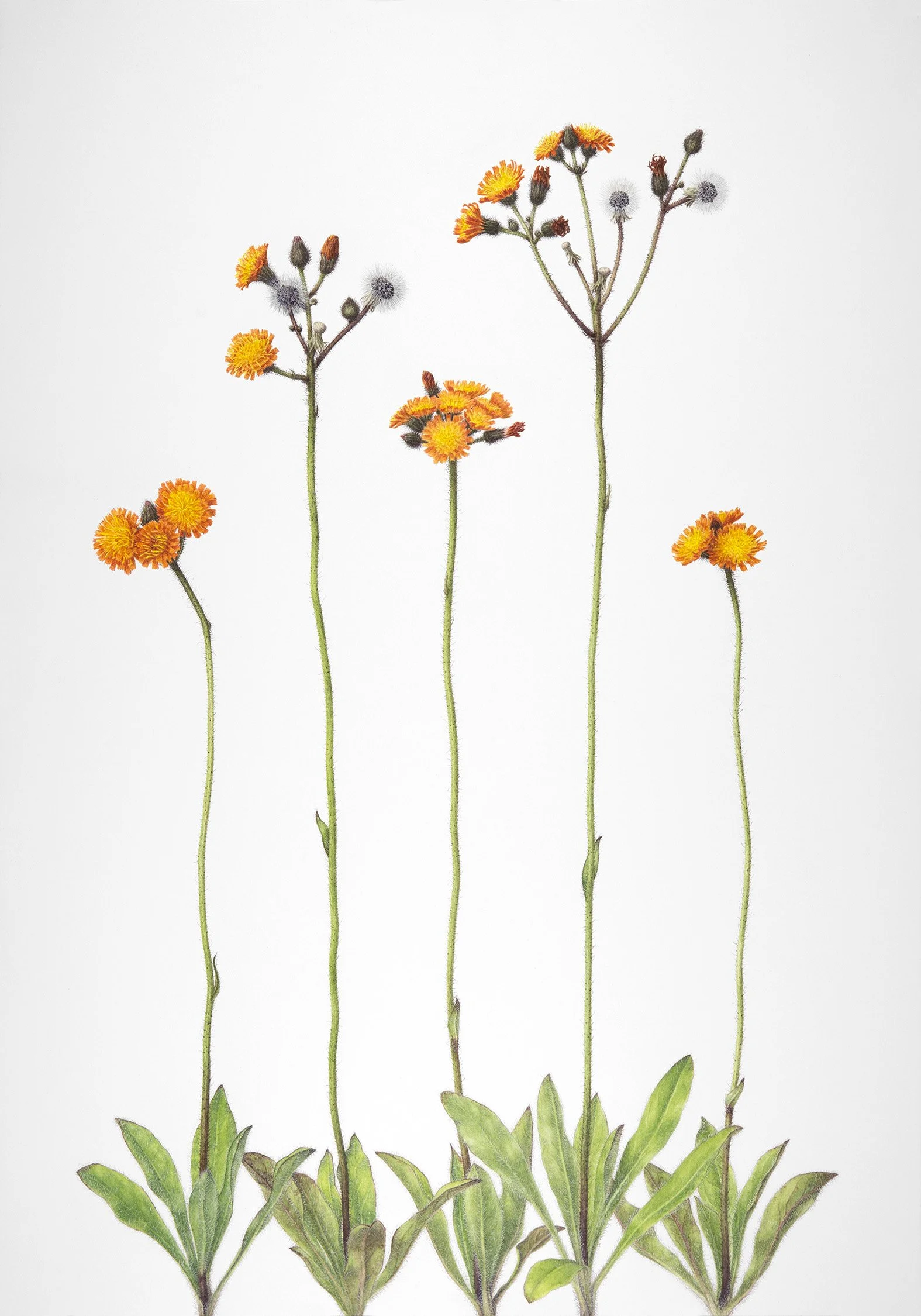
Pilosella aurantiaca (Orange Hawkweed), 2025
watercolour on paper, 20” x 14”
Native to Europe, Pilosella aurantiaca was brought to North America as a garden ornamental. Valued for its vibrant orange flowers, by 1875 it was being cultivated in gardens in Vermont, and remained a popular plant for many decades. Attractive to both humans and pollinators, orange hawkweed is still occasionally included in wildflower seed mixes. To help prevent new infestations, avoid planting seed mixes that do not clearly identify their contents.
There are three species of hawkweed native to Alberta. Invasive hawkweeds were first documented in western Canada by the mid-twentieth century, and at least five invasive species are now established in Alberta. Formerly classified within the genus Hieracium, hawkweeds are now divided into the genera Hieracium and Pilosella. In Alberta, all species in the genus Pilosella are considered invasive, while our native species remain within the genus Hieracium.
Orange hawkweed is an aggressive and remarkably adaptable plant. Below ground it spreads through rhizomes, while above ground it produces creeping stolons that allow new plants to establish nearby. Like dandelions, it produces fluffy wind-dispersed seeds. Unlike dandelions, however, orange hawkweed is an apomict: it can produce viable seeds without pollination and fertilisation. Developing seeds can even reach maturity after the plant has been pulled from the ground.
Research also suggests that orange hawkweed is allelopathic. Compounds present in its pollen may interfere with the reproduction and development of nearby plants when transferred by pollinators. Additional compounds may also be released through its roots into the soil, further weakening neighbouring species. Combined with its multiple reproductive strategies, these abilities allow orange hawkweed to form dense colonies and displace native vegetation.