
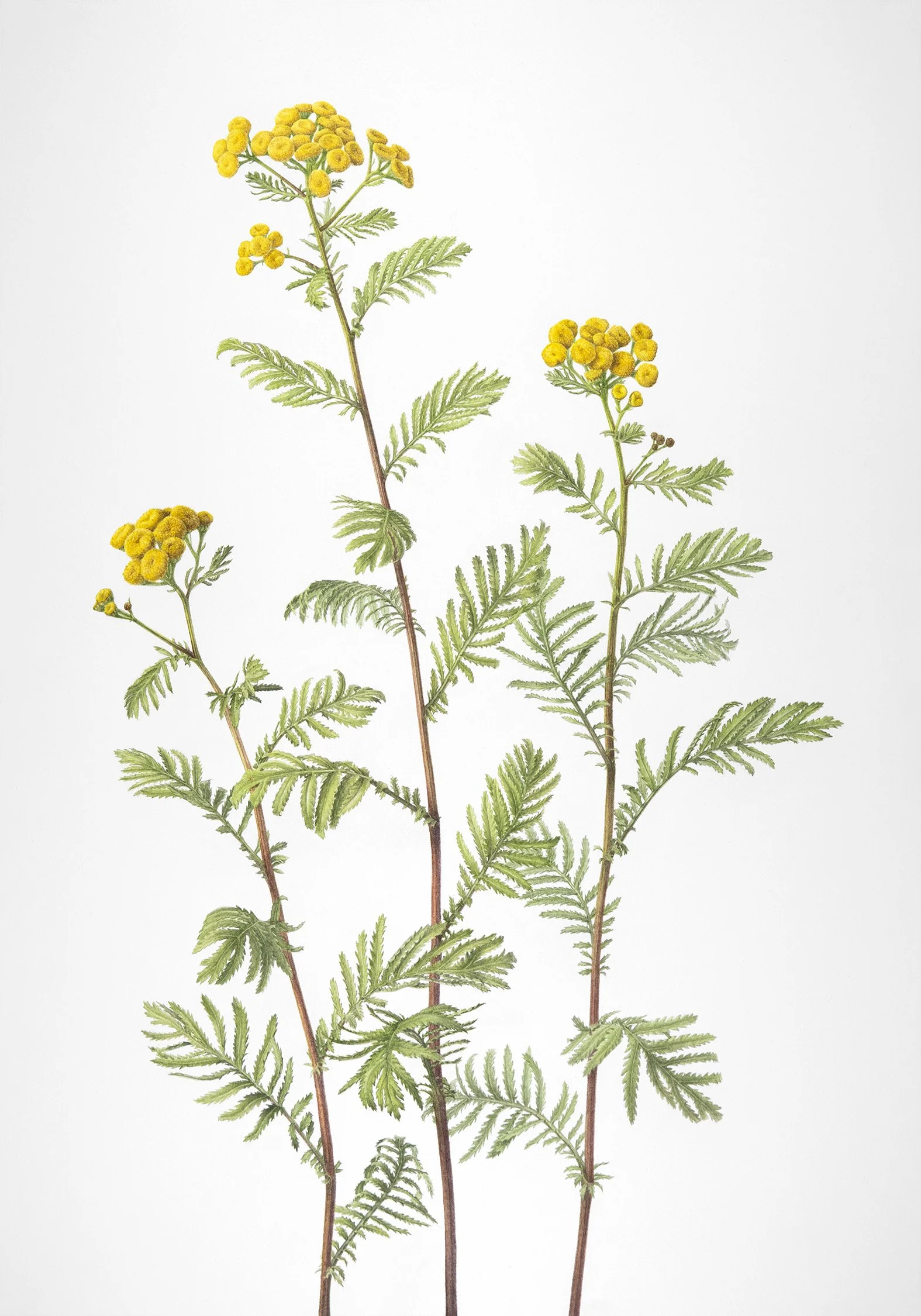
Tanacetum vulgare (Common Tansy), 2025
watercolour on paper, 20” x 14”
Native to Europe and much of Asia, Tanacetum vulgare was introduced to North America by European settlers in the seventeenth century. Valued as both a medicinal herb and an insect repellent, it was commonly grown in colonial gardens before escaping cultivation and spreading across much of the continent. The earliest evidence of the plant in Alberta dates to the late nineteenth century.
As with all plants in the Asteraceae family, what appears to be a single flower is actually a composite flower head made up of many individual tiny florets. Each yellow button-like flower head of common tansy may contain up to one hundred individual florets. Each plant can produce as many as two hundred flower heads and between 2,000 and 50,000 seeds a year. Seeds can remain viable for up to twenty-five years and are dispersed by wildlife, water, and human activity. In addition to reproducing by seed, tansy also spreads through underground rhizomes and roots, allowing established populations to expand quickly.
The leaves of common tansy contain thujone, a neurotoxin also found in wormwood, and long believed to be responsible for the hallucinogenic effects associated with absinthe. Thujone and pyrethrins—natural compounds used in botanical insecticides—make common tansy an effective insect repellent. Early settlers took advantage of these properties to help preserve meat before the advent of refrigeration by discouraging insects and other pests. Until the nineteenth century, the plant was also used as an embalming substitute by wrapping corpses in its leaves.
In traditional medicine, tansy was used to treat a variety of ailments including intestinal parasites, digestive problems, and menstrual pain. However, in large quantities it can be toxic to humans and animals, and the plant’s oils may cause skin irritation and allergic reactions.
Today, perhaps the most useful application of common tansy is for textile artists—the flowers produce a vibrant, lightfast yellow dye.